TaPRA Research Prize for Editing (Essay Collections and Special Issues)
This prize is for an edited collection (a book of essays or a special issue of a journal) that defines new approaches in research in theatre and performance, opening up new areas of work and new lines of enquiry.

PRIZES
2026
WINNER
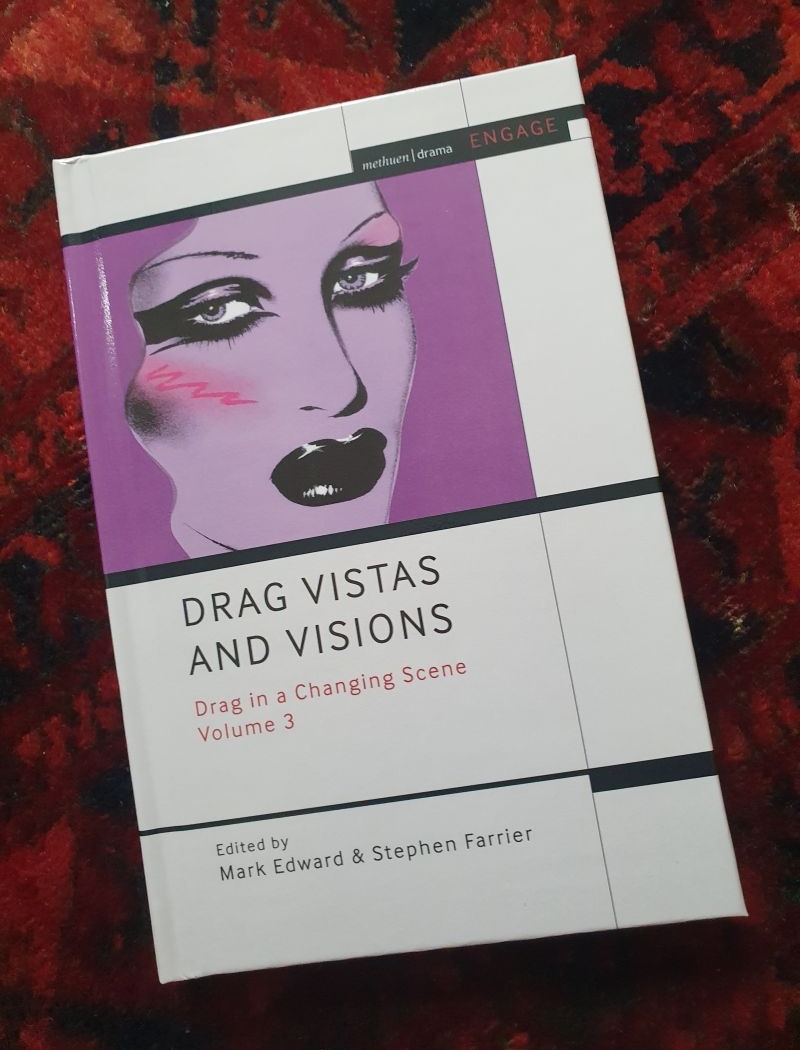
Mark Edward and Stephen Farrier
Drag Vistas and Visions: Drag in a Changing Scene, Volume 3, Methuen Drama, 2025.
This is a productively wide-ranging collection that makes a significant contribution to the field through its breadth of approach, which includes detailed attention to particular artists and practices, intersectional perspectives, and valuable work on queer Asian artists. The essays are consistently thoughtful, well theorised, lively and engaged with current debates, and the selection demonstrates careful and inclusive curation.
The collection’s particular strength lies in the texture and variety of its examples and in its openness to disobedience, resistance and alternative ways of thinking about academic practice. It is a rich collection which bravely and rigorously examines the contexts outside mainstream drag performance to appraise and decolonise contemporary drag practice. The pinnacle of the editorial work in this collection is in its ability to demonstrate that each chapter connects through a deep response and critique of existing feminists and queer frameworks within which drag scholarship currently tends to sit, arguing that drag is not just a space to be held creatively, or a queer practice to be studied, but a core critical framework and a field in itself.
SPECIAL MENTION
Eirini Kartsaki
Obsessions of a Showwoman: The Performance Worlds of Marisa Carnesky, Intellect Books, 2024.
Dassia N. Posner, Claudia Orenstein, Alissa Mello
Making Meaning in Puppetry: Materials, Practice, Perception, Routledge, 2026.
PRIZES
2025
WINNER
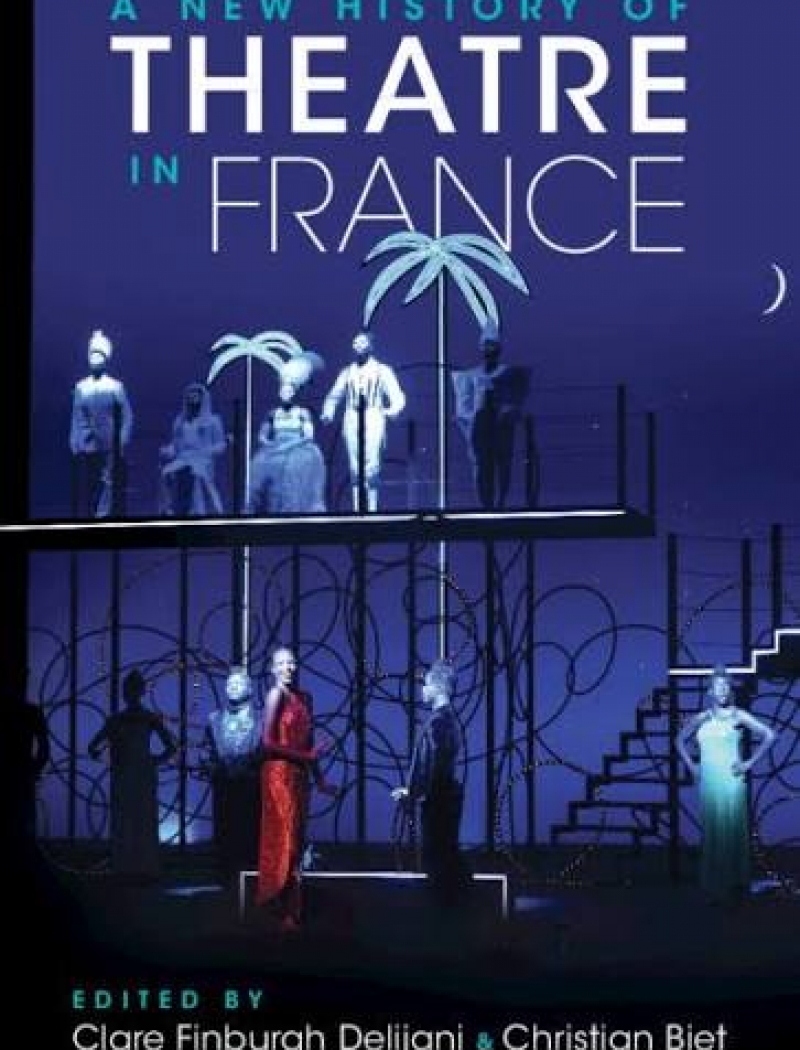
Clare Finburgh Delijani (with Christian Biet)
A New History of Theatre in France, Cambridge University Press, 2024.
Clare Finburgh Delijani’s A New History of Theatre in France is an outstanding achievement in theatre historiography and an invaluable contribution to both theatre and performance studies and modern languages. This updated and comprehensive English-language reference work offers a vital rethinking of French-language theatre on the territory of what is today France, bridging disciplinary and linguistic divides with remarkable clarity and insight. This is an invaluable publication for the field: ambitious in scope, elegant in execution, and transformative in its potential impact.
SPECIAL MENTION
Tracy Davis and Paul Rae
The Cambridge Guide to Mixed Methods Research for Theatre and Performance Studies, Cambridge University Press, 2024.
PRIZES
2024
WINNER
Nesreen N. Hussein
Co-Editors: Kevin Brown, Felipe Cervera, Theron Schmidt
‘Decolonisation and Performance Studies’, Global Performance Studies, vol. 5, nos. 1–2, 2022
A stunning demonstration of coalitional authorship and curation, “Decolonisation and Performance Studies” broadens research agendas in the field around the epistemological exclusions created by capitalist empire. Attentive to the material conditions that both constrain and enable knowledge production in globally uneven ways, this special double issue performs what it champions: privileging modes of academic writing suited to transnational conversation and committing to de-center the English language in Theatre and Performance Studies. At a historical moment marked by the resurgence of genocidal violence in Palestine, “Decolonisation and Performance Studies” is a testament to how the field is grappling with settler colonialism and a stark reminder of all that there is still to do.
SPECIAL MENTION
Sean Metzger and Roberta Mock
The Methuen Drama Handbook of Gender and Theatre. London: Bloomsbury, 2024.
Alyson Campbell, Stephen Farrier, Manola-Gayatri Kumarswamy
What’s Queer About Queer Performance Now? Contemporary Theatre Review, Volume 33, Issue 1-2 (2023)

PRIZES
2023
WINNER
Amy Mihyang Ginther
Stages of Reckoning: Antiracist and Decolonial Actor Training. London: Routledge, 2022.
It is with great joy that we announce Stages of Reckoning Antiracist and Decolonial Actor Training as the winner of the TaPRA Prize for Edited Collections. This is a joyous, urgent and heartfelt book which invites the reader in with care offering a challenge and a call to take action. It is a sensitively curated collection, which carefully situates and critiques actor training within existing hegemonies of whiteness and coloniality. It creates a space in which a conversation about the needs of Global Majority acting students are placed at the centre. It names and acknowledges the additional labour, effort and work required by these students and questions and challenges this experience. The book offers exciting and challenging discussions and considerations of pedagogy for the field as a whole. In particular we wish to commend the editor for their considered acts of editorial care and support extended to the contributors, placing special consideration to the writing conditions of the contributors. This book epitomises the TaPRA manifesto.
SHORTLISTED
Julia Listengarten and Yana Meerzo
Performing Arousal: Precarious Bodies and Frames of Representation. London: Bloomsbury, 2021
Martin Middeke and Martin Riedelsheimer
Critical Theatre Ecologies special issue, Journal of Contemporary Drama in English, 10.1 (2022)
WINNING
The Prize
TBC
2022
 Melissa Blanco Borelli, Bryce Lease and Royona Mitra

for “Outing Archives/Archive Outings”, special issue of Contemporary Theatre Review, 31:1–2
Dassia N. Posner, Kevin Bartig and Maria De Simone
Three Loves for Three Oranges: Gozzi, Meyerhold, Prokofiev, Indiana University Press, 2021
Clare Parfitt
Cultural Memory and Popular Dance: Dancing to remember, dancing to forget (Palgrave Macmillan, 2021)
2021
 Theron Schmidt

for Agency: A Partial History of Live Art (University of Chicago Press, 2019)
The judging panel agreed that Agency: A Partial History of Live Art is an elegant and beautifully presented mapping of important themes and topics in Live Art. The lens of agency provides an original perspective as well as providing a well-deserved tribute to the work of the Live Art Development Agency. The editorial strategy for the volume is very clearly articulated and the variety of voices and registers was extremely well curated and framed. The work is very precisely edited with an excellent introduction to each sub-section. All the elements, including the images, are effectively integrated in a coherent totality.
Siân Adiseshiah and Jaqueline Bolton
debbie tucker green: Critical Perspectives (Palgrave Macmillan, 2020)
Katie Beswick
Housing, Performance and Activism (Studies in Theatre and Performance, 2020, 40:1)
Claire Cochrane and Jo Robinson
The Methuen Drama Handbook of Theatre History and Historiography (Methuen Drama, 2019)
2019
Richard Gough
for Performance Research 24(3), On Reflection: Turning 100
Both the shortlisting panel and the final judging panel found this special issue of PR a monumental achievement. The judges commended the ambition and innovation of its concept: to commission an original essay on each of the themes chosen for each of 100 special issues of the journal. This framework produced a fascinating set of essays that were often formally innovative and conceptually rich. Excellence in editing is shown not only by the management of such an enormous project, but also in the layers of a plurality of inter-generational voices speaking to the edited work of the journal itself. The result is an encyclopaedic but creatively anarchic view of the field. Like the issue itself, theatre and performance studies is revealed to be interesting, odd, motile, dynamic, and plural. On Reflection: Turning 100 is less a guide to theatre and performance studies than a wander, and thus opens new possibilities for editorial practice.
Geraldine Brodie and Emma Cole
Adapting Translation for the Stage (Routledge, 2017)
Kate Dorney and Maggie Gale
Vivien Leigh: Actress and Icon (Manchester University Press, 2017)
Scott Palmer and Joslin McKinney
Scenography Expanded: An Introduction to Contemporary Performance Design (Bloomsbury, 2017)
2017
Maria Delgado & Joanne Tompkins
for Contemporary Theatre Review: The Politics, Processes and Practices of Editing: special edition. 25:1, February 2015.
 The collection notes the relative invisibility of the labour of editing, and goes a long way to bring, in the words of the sub-title, the politics, processes and practices of editing into the light. The introduction effectively maps debates and issues, arguing for editing, in all its many forms, as one of the main ways in which academic disciplines mark where they are and chart a path to the future: as one of the sub-headings has it, it is about ‘The value of editing/ [as well as] the editing of value’, and as such it is a timely and welcome contribution to ongoing debates in the discipline about the value of editing to our research culture.
Helen Nicholson & Anna Harpin
for Performance and Participation: Practices, Audiences, Politics (Palgrave, 2016)
Alyson Campbell & Stephen Farrier
for Queer Dramaturgies: International Perspectives On Where Performance Leads Queer (Palgrave, 2016)
MAKE A
Nomination
Only current TaPRA members can submit nominations for our awards or elections. Each nomination requires a seconder, who must also be a current member.
TaPRA 2026 at QMUL
Our 2026 conference will be hosted in partnership with the Queen Mary University London, 2–4 September 2026
TaPRA 2026 at QMUL
Our 2026 conference will be hosted in partnership with the Queen Mary University London, 2–4 September 2026